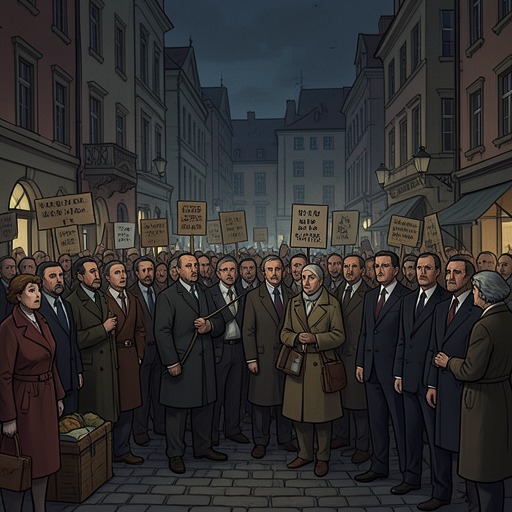
Giacinto Menotti Serrati
M: Son of the CenturyGiacinto Menotti Serrati was a leading figure of the Italian Socialist Party’s maximalist wing during the volatile postwar years. A former dockworker who had unloaded coal and a former editor of Avanti!, he embodied the movement’s union of working-class experience, revolutionary rhetoric, and mass politics. He helped keep revolution at the center of socialist debate, yet the narrative repeatedly sets that expectation against the party’s hesitation, its internal divisions, and the growing power of armed fascism.
Identity and political position
Serrati’s identity in the account is defined chiefly by his place within the Italian Socialist Party. He led its maximalist section, the current that looked to the Bolshevik Revolution as a model and treated the prospect of a Soviet republic in Italy as a serious political horizon. His background as a stevedore, followed by his work as a socialist journalist, distinguished him from the salon intellectuals whom Nicola Bombacci criticized. In 1914, Serrati replaced Benito Mussolini as editor of Avanti!, a succession that connected his career to the newspaper and to the party’s public voice.
The account presents Serrati as a forceful organizer and speaker, but not as the sole author of the party’s direction. He operated among reformists who favored parliamentary and gradual approaches, maximalists who proclaimed revolution, and communists urging a more decisive break. His leadership therefore meant managing competing expectations as much as advancing a single program.
Mobilizing the revolutionary expectation
In the unsettled atmosphere of 1919, Avanti!, under Serrati’s editorship, kept workers alert to the possibility of an imminent revolutionary wave. The paper’s daily emphasis on upheaval contributed to a wider mood of expectation, fed by events elsewhere in Europe: socialist and communist governments had been proclaimed in Bavaria and Hungary, while the Russian Revolution and the Red Army offered a model that many Italian workers watched closely. The narrative describes this atmosphere as prolonged vigilance rather than a single moment of uprising. The imagined revolution was repeatedly near, but its timing and practical means remained uncertain.
On July 20, 1919, Serrati spoke at a Milan rally held outside the Labor Office on Via Manfredo Fanti. Claudio Treves had already addressed the crowd, and workers were waiting for Nicola Bombacci, whose popularity made his appearance the anticipated climax. The gathering was festive rather than openly mutinous: workers enjoyed an unusual morning away from work while mounted troops patrolled nearby streets. Serrati’s place between Treves and Bombacci captures his position within the movement: he was a prominent representative of its maximalist leadership, but part of a collective political stage on which different speakers voiced different tendencies.
The account also connects Serrati to a socialist procession on Via San Damiano, where demonstrators had stopped beneath the windows of Avanti! to hear him praise socialism. As the procession began moving again, an object thrown from a bridge exploded near its front. The newspaper’s report described the assailant as unidentified and the incident as the act of a fanatic. Serrati is present in the circumstances of the procession as its speaker; the account does not assign him responsibility for the violence that followed.
Revolution, force, and the limits of party strategy
At the Bologna congress of the Italian Socialist Party, the maximalist majority adopted a platform inspired by the Bolshevik Revolution, described as the most auspicious event in proletarian history. The party revised its program in preparation for revolution and appointed Bombacci secretary. Serrati’s leadership belonged to this larger turn: the party publicly oriented itself toward a Soviet republic, even as its leaders continued to disagree over what revolutionary action required and when it should begin.
The narrative makes that disagreement concrete through the debate over violence. Gennari called it historically necessary; Lazzari urged waiting for certainty; Serrati argued that the terrain should be tested before the decisive move; and Turati considered the prospect reckless. Turati’s warning was grounded in the imbalance between the two sides: socialist leaders had not experienced the front as their fascist opponents had, and the fascist squads were far better armed. The account’s contrast between the hammer and sickle and the dagger condenses the strategic problem Serrati faced. Revolutionary symbols could express commitment, but they did not by themselves supply the organization or force needed to overcome armed opponents.
The socialist parliamentary walkout later exposed another limit. Serrati left Montecitorio with the dissident deputies, and his appearance before the sovereign gave the action a dramatic public form. The deputies’ exhilaration outside the chamber was short-lived: they had no plan for what to do next. Nationalist gangs then attacked them in the streets, and the newly formed Royal Guard entered the repression. Serrati was taken to security headquarters and assaulted. The episode placed the consequences of a theatrical act of withdrawal beside its lack of a practical next step, while showing how quickly political opponents could exploit that gap.
Leadership and the socialist split
Serrati’s most consequential party decision came at the Italian Socialist Party congress in Rome on October 3, 1922. The assembly sought to avoid another split, since division seemed to threaten both revolutionary action and reformist collaboration. Yet Serrati proposed expelling the reformists, and the motion passed by only a handful of votes. Filippo Turati and Giacomo Matteotti were among those expelled, along with Claudio Treves, Giuseppe Saragat, and Sandro Pertini.
The expelled members formed the Unitary Socialist Party and elected Matteotti secretary. At the same time, the congress resolved to join the Communist International and send a new delegation to Moscow. These outcomes sharpened rather than settled the strategic conflict: the party moved closer to international communism while losing experienced reformists who had spent their lives in its ranks. Serrati’s vote was not simply another expression of maximalist belief; it helped turn a long-running disagreement into an institutional division with lasting consequences for the Italian left.
Narrative significance
Serrati’s arc is marked by the widening distance between the language of imminent revolution and the means available to realize it. As editor, speaker, and party leader, he helped sustain revolutionary expectation among workers. But the episodes associated with his leadership also show the costs of uncertainty: socialist leaders debated whether to act, withdrew from parliament without a plan, and ultimately divided their movement. His warning that the terrain must be tested before a decisive move sits uneasily beside the maximalist program he helped advance. That tension makes him a significant figure in the account—not as a solitary architect of events, but as a leader caught between revolutionary aspiration, tactical caution, and the escalating force of fascist opposition.